How much protein should you eat as a woman? How to get a firm and strong body
Protein isn’t just for bodybuilders or people who train hard. It’s one of the most important building blocks in your body, every single day, whether you go to the gym or not. Yet it’s one of the nutrients most women get too little of. Here’s the evidence-based review. What protein does, how much you actually need, and how to get it with regular Danish food.
Table of contents
What protein actually does in the body
Protein is the body’s building material. It is used for far more than muscle. Your skin, hair and nails are made of proteins such as collagen and keratin. Collagen is the most abundant structural protein in the body and makes up about 30 percent of all the protein you have (source: nutrition science, open textbooks).
Protein is also the raw material for enzymes that control chemical processes in the body, and for many of the hormones that regulate metabolism, growth, and mood. Your immune system uses protein, and the body repairs and renews cells with protein all the time (source: nutrition science, open textbooks).
In other words, even if you never lifted a weight, your body needs protein every day just to function and renew itself.
Why it becomes more important with age
From around the age of 30, we slowly start to lose muscle mass. At the same time, something important happens. The body becomes less able to utilize the protein you eat. This is called anabolic resistance. Older muscles are less sensitive to small amounts of protein and require a larger portion to trigger the same muscle building as younger ones (source: PROT-AGE, Bauer et al. 2013).
Therefore, your protein needs actually increase with age, at the same time that many eat less. For women, it becomes extra relevant around menopause, when muscle loss accelerates. Protein is a big part of the solution.
How much protein should you eat?
It depends on your goal. Here are the levels that the research points to.
The old international minimum is 0.8 grams of protein per kilogram of body weight per day. But the Danish and Nordic recommendations are higher. For adults, the reference is around 1.1 grams per kilogram, and for people over 65 around 1.2 grams per kilogram, increasing to 1.2 to 1.5 grams for the oldest (source: Nutrition Focus, based on the Nordic Nutrient Recommendations 2023). A completely normal level of exercise and fitness is covered by approximately 1.1 grams per kilogram (source: Nutrition Focus).
If you train specifically to build or maintain muscle, sports nutrition is recommended at a higher level.
Team Denmark recommends 1.4 to 2.0 grams per kilogram for athletes, and 1.6 to 2.2 grams per kilogram for strength athletes (source: Team Denmark). The international sports nutrition association ISSN does the same (source: ISSN Position Stand, Jäger et al. 2017). Team Denmark also notes that there is no evidence that more than 2.0 grams per kilogram provides additional benefits.
More than that rarely provides any extra benefit. The most thorough recent meta-analyses indicate that gains in muscle and strength peak around 1.5 to 1.6 grams per kilogram, and that more protein only provides small additional gains (source: Tagawa et al. 2021 and 2022; Nunes and Phillips 2022). A randomized study from 2023 also found no additional benefit from doubling from 1.6 to 3.2 grams per kilogram (source: randomized study, 2023). So you don’t need to overdo it.
And an honest note. Much of the research has been done on men and mixed groups.
High-quality studies specifically on postmenopausal women are still few, and a few of them found only a small additional gain above about 1.2 grams per kilogram when exercising (source: Randomized trials in postmenopausal women, 2017 and 2019; narrative review, 2024).
Therefore, a level around 1.6 grams per kilogram is a reasonable and well-tolerated target, not a magic number.
From a real-world perspective, the key point is different. For most people, the problem isn’t getting above 1.6 grams per kilogram. It’s getting there at all. Many are well below, and some, especially older women, are as low as 0.5 to 0.8 grams per kilogram.
Just getting to around 1.6 grams per kilogram makes a world of difference for most people.
Eating much more than that can also be difficult in practice if you want to stay away from ultra-processed products and protein powders. Therefore, 1.6 grams per kilogram is a realistic and effective goal for the vast majority of people. If you want to go higher, it makes the most sense if you practice sports at a high level, or if you have the appetite and energy for it. But that is rarely what determines the result. Find your level based on your goal and be persistent.
A concrete example. I recommend most people aim for around 1.6 grams per kilo. For a 70 kilo woman, that’s about 112 grams of protein per day.
An important detail about the calculation. Use your weight if you are of normal weight. If you are overweight, do not calculate based on your full weight, because the extra fat makes the number look artificially high, and fat mass does not have the same need for protein as muscle. Instead, use your ideal weight as a starting point.
Equally important is the distribution. The body can best utilize protein when it is distributed throughout the day, not all at once. Research suggests that about 25 to 40 grams of good quality protein per main meal, or about 0.25 to 0.4 grams per kilogram, is needed to kick-start muscle building (source: ISSN Position Stand, Jäger et al. 2017; PROT-AGE, Bauer et al. 2013). So three good meals with protein beats one big protein meal in the evening.
Protein and weight
If you want to lose weight or maintain it, protein is your best friend. There are three reasons for this.
Protein is more satiating than fat and carbohydrates. This means you can eat less without feeling hungry (source: review in the Journal of Obesity & Metabolic Syndrome, 2020).
Protein protects your muscle mass when you lose weight. Studies show that a diet with more protein preserves more muscle and leads to greater fat loss than a diet with less protein during weight loss (source: review in the American Journal of Clinical Nutrition). A meta-analysis found up to 1.2 kilograms more muscle mass was preserved on a high-protein diet compared to a low-protein diet.
Finally, the body uses more energy to digest protein than fat and carbohydrates. This is a small but real extra burn (source: review in the Journal of Obesity & Metabolic Syndrome, 2020).
Protein and exercise
If you’re strength training, protein helps you get more out of it. The most thorough meta-analysis to date, including 49 studies with 1,863 participants, found that supplementing with protein increases both strength and muscle mass after strength training (source: Morton et al. 2018, British Journal of Sports Medicine).
The same analysis found that muscle mass gains plateaued at around 1.6 grams per kilogram per day, and more recent analyses place the plateau somewhere between 1.6 and 2.2 grams per kilogram (source: Morton et al. 2018, BJSM; ISSN Position Stand, Jäger et al. 2017). More than that rarely provides any extra muscle growth. So you need to hit a sensible level and be persistent, not binge eat.
The important message: Protein and exercise are what keep your strength going, especially as you get older. It’s the difference between being able to carry groceries, get up off the floor and maintain your independence, or slowly losing it.
Where do you get the protein from?
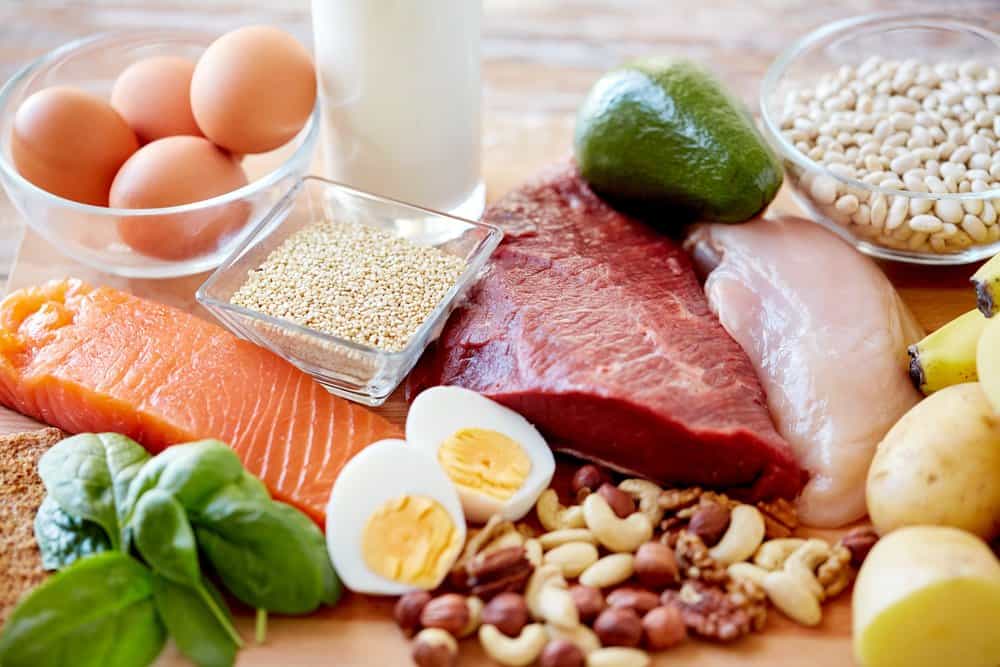
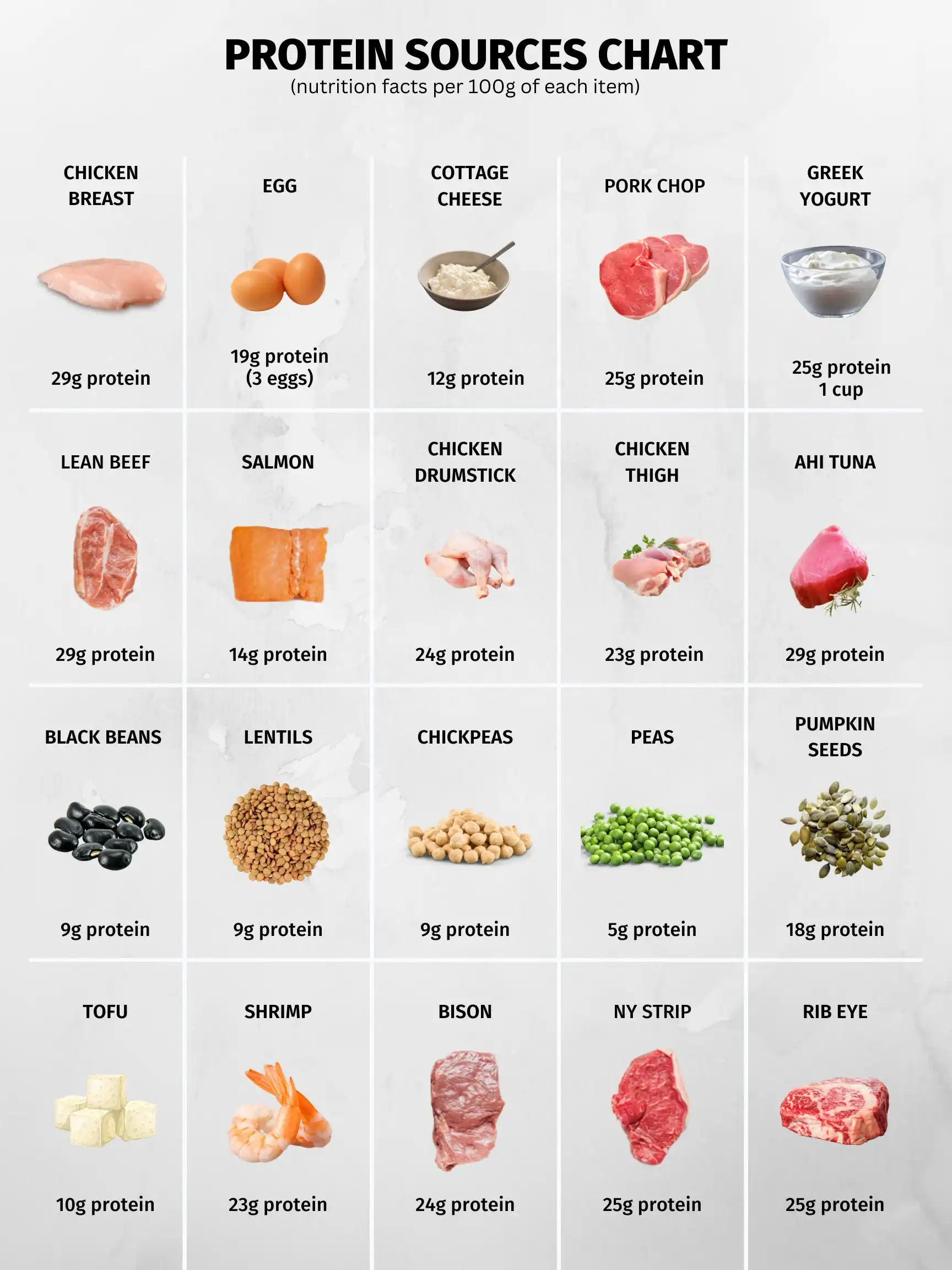
You don’t need special products. Ordinary Danish food will go a long way. Here is the protein content per 100 grams (source: DTU Food Data, December 2023).
Animal sources:
- Chicken breast, raw: 22 grams
- Beef tenderloin, raw: 21 grams
- Cheese 30+: 28 grams
- Cottage cheese 5%: 13 grams
- Whole eggs: 12 grams (about 6 to 7 grams per egg)
- Skyr 0.2%: 11 grams
Vegetable sources:
- Almonds: 26 grams
- Oatmeal: 14 grams
- Edamame beans: 12 grams
- Cooked chickpeas: 7.2 grams
- Cooked green lentils: 6.6 grams
Animal sources typically contain all the essential amino acids in the right amounts. If you eat plant-based, you can achieve the same by combining multiple sources, such as beans and whole grains, and by eating a little more in quantity.
What a day might look like
An example of how a 70-kilo woman can reach her approximately 112 grams of protein with completely normal food, distributed throughout the day:
- Breakfast: A bowl of skyr (200 grams, about 22 grams of protein) with oatmeal and a handful of almonds. About 30 grams in total.
- Lunch: Two to three pieces of rye bread with 2 hard-boiled eggs and mackerel in tomato or chicken (about 28 grams). A completely normal Danish lunch.
- Snack: A bowl of cottage cheese or skyr (about 18 to 20 grams).
- Dinner: A normal portion of chicken, fish or lean meat (about 130 grams, about 30 grams) with potatoes or rice and vegetables. A total of about 34 grams.
That gives you about 110 grams of protein, evenly distributed, without a single protein powder. If you exercise a lot, you can increase the portions a little or add a protein-rich snack.
Protein powder and supplements
Should you have protein powder? Short answer: It’s not necessary, but it can be convenient. Whole foods should be the foundation. They provide protein plus vitamins, minerals, and satiety. But if you have difficulty reaching your goal through food, for example on a busy day or after a workout, a protein shake is an easy and inexpensive help.
Powders are not better than food. They are just protein in a convenient form. Choose a product with few ingredients and think of it as a supplement, not a replacement for real meals.
Is too much protein dangerous for the kidneys?
This is a common concern, and for healthy people the answer is no. A meta-analysis of 28 studies with 1358 participants found that a high-protein diet does not impair kidney function in healthy adults (source: Devries et al. 2018, The Journal of Nutrition). The researchers concluded that there is no evidence linking a high-protein diet to kidney disease in healthy people.
The Danish authorities support this. There is no defined safe upper limit for healthy adults, and a Danish review shows that up to 23 percent of energy from protein is safe. The Danish dietary guidelines recommend a maximum of 20 percent of energy from protein (source: DTU Food Institute, NNR 2023).
If you already have kidney disease, that’s a different matter. Then you should talk to your doctor about your protein intake. For everyone else, there is no reason to fear the amounts recommended here.
The most important thing to remember
Protein is not just for those who work out. It is the building block for skin, hair, nails, hormones, immune system and muscles, every single day. As we age, the need increases, while the body becomes less able to utilize it. That is why protein is one of the simplest and most effective things you can adjust to keep you firm, strong and functional throughout life.
You don’t have to eat like a bodybuilder. For most people, it’s not about pushing the amount as high as possible, but about getting to a reasonable level of around 1.6 grams per kilo, spreading it out over the day, and combining it with some training. That’s where the big difference lies.
If you’re curious about how little it really takes to see long-lasting results, book a free consultation. We’ll look at your current situation and talk about how your training and diet can support you, right from where you are now.
Sources
- Healthline. 9 Important Functions of Protein in Your Body. https://www.healthline.com/
nutrition/functions-of-protein